Topic: nuclear power - on March 16, 2011 at 6:22:00 PM CET
Atomkraft ist SO SICHER,
dass Atomkraftwerke nicht versicherbar ist. Jedenfalls nicht gegen schwere Naturkatastrophen. Da reden sich die Versicherungen ja auch sonst gerne mit "höherer Gewalt" raus. Daher haftet der Steuerzahler.
... Link (0 comments) ... Comment
Topic: nuclear power - on March 16, 2011 at 6:18:00 PM CET
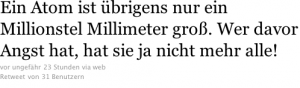
Deutsches Atomforum kündigt rechtliche Schritte gegen Satire an
Unter @Atomforum_eV werden gerade bei Twitter interessante Kommentare zur Lage in Japan und den politischen Konsequenzen in Deutschland getwittert.
... Link (0 comments) ... Comment
Topic: nuclear power - on March 16, 2011 at 5:26:00 PM CET
IAEA-Chef fliegt nach Japan: Situation „sehr ernst“
Der Chef der Internationalen Atomenergiebehörde (IAEA) in Wien, Yukiya Amano, hat die Situation in Fukushima I als „sehr ernst“ bezeichnet. Er werde so schnell wie möglich selbst nach Japan fliegen, sagte der Japaner heute in Wien. Er werde eine Nacht in Tokio verbringen, um dann zurück nach Wien zu reisen. Er wisse bis dato noch nicht, mit wem er sprechen wird, aber es sollen Kontakte auf „höchstem politischen Niveau“ sein. In Wien werde er nach seiner Rückkehr eine Sondersitzung des Gouverneursrats einberufen.
... Link (0 comments) ... Comment
Topic: nuclear power - on March 16, 2011 at 8:50:00 AM CET
Japan stocks surge after rout, relief for Asia
Asian financial markets rallied on Wednesday, with Tokyo stocks rebounding 5.7 percent after a steep two-day sell-off on Japan's killer earthquake and unfolding nuclear crisis.
Other Asian stock markets were also higher, but another fire at the earthquake-damaged Fukushima Daiichi nuclear plant north of Tokyo and fears of more radiation leaks kept investors on edge and Tokyo stocks volatile.
... Link (0 comments) ... Comment
Topic: nuclear power - on March 16, 2011 at 8:01:00 AM CET
Govt: radiation spike likely from No.2 reactor
Japan's nuclear safety agency says a possible radiation leak from the Number Two reactor may have caused the sharp increase in radiation levels on Wednesday at the Fukushima Daiichi nuclear power station, north of Tokyo.
The Nuclear and Industrial Safety Agency told reporters on Wednesday that the level of radiation near the plant's main gate rose to 10 millisieverts per hour at 10:40 AM, but dropped to 2.7 millisieverts per hour within 30 minutes.
... Link (0 comments) ... Comment
Topic: nuclear power - on March 16, 2011 at 7:57:00 AM CET
Japan quake radioactive material monitoring post MAP
... Link (0 comments) ... Comment
Topic: nuclear power - on March 16, 2011 at 7:52:00 AM CET
Da es bisher keine EU-weite rechtliche Grundlage dafür gebe, sei die Teilnahme an dem "Stresstest" freiwillig, sagte Oettinger. Aber er gehe davon aus, dass sich "möglichst alle" beteiligen.
Teilnahme am Test ist freiwillig
Man werde nun schauen, wo die Sicherheitsvorschriften in Europa am strengsten seien, so Oettinger. Dann würden die schärfsten Regeln europäisiert. Da es bisher keine EU-weite rechtliche Grundlage dafür gebe, sei die Teilnahme an dem "Stresstest" freiwillig, sagte Oettinger. Aber er gehe davon aus, dass sich "möglichst alle" beteiligen. Dazu forderte er auch Russland und die Schweiz auf. Und wenn ein Kraftwerk die Tests nicht bestehe, müsse es vom Netz, machte der Kommissar klar: "Die Autorität muss so hoch sein, dass jeder im Rahmen seiner rechtlichen Verantwortungen seine Folgerungen zieht." Womöglich müsse die EU-Richtlinie für Sicherheit der Kernenergie überarbeitet werden.
... Link (0 comments) ... Comment
Topic: nuclear power - on March 16, 2011 at 7:51:00 AM CET
If the readings have gone from 20 to 40, how bad it this?
... Link (0 comments) ... Comment
Topic: TOYS - on March 16, 2011 at 7:41:00 AM CET
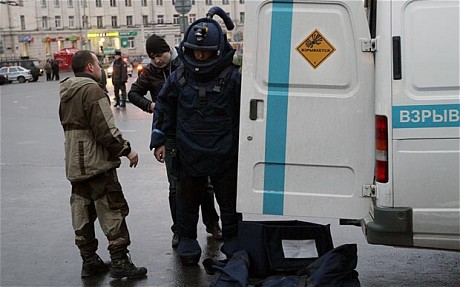
Russian bomb squad called in to defuse sex toy
Anti-terrorist bomb squad experts were called to a post office in the northwest of Russia to make safe a package from which a strange ticking sound was coming, local police said on Monday.
They found a vibrator.
... Link (0 comments) ... Comment
Topic: TV - on March 16, 2011 at 7:38:00 AM CET
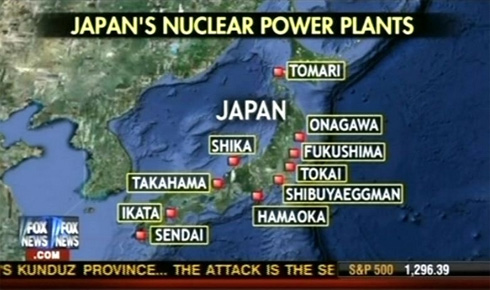
Fox News – Clueless About Japanese Nuclear Plants
A screen capture from some of the Fox New Channel’s coverage of the nuclear reactor incident in Japan
... Link (0 comments) ... Comment
Topic: nuclear power - on March 15, 2011 at 5:52:00 PM CET
Strahlenbelastung
Als Strahlenbelastung oder auch Strahlenexposition bezeichnet man die Einwirkung von ionisierender Strahlung auf Lebewesen oder auf Materie. Im Gegensatz zum Begriff Strahlenexposition setzt Strahlenbelastung im Sprachgebrauch des Strahlenschutzes eine schädigende Wirkung voraus.
... Link (0 comments) ... Comment
Topic: nuclear power - on March 15, 2011 at 5:47:00 PM CET
Caesium
Caesium (nach IUPAC), standardsprachlich Cäsium oder Zäsium (im amerikanischen Englisch Cesium), ist ein chemisches Element mit dem Elementsymbol Cs und der Ordnungszahl 55. Im Periodensystem steht es in der 1. Hauptgruppe und gehört zu den Alkalimetallen. Caesium ist das schwerste stabile Alkalimetall.
Caesium wurde 1861 von Robert Wilhelm Bunsen und Gustav Robert Kirchhoff in Dürkheimer Mineralwasser entdeckt. Aufgrund der zwei blauen Spektrallinien, mit denen das Element nachgewiesen wurde, nannten sie es nach dem lateinischen caesius für himmelblau. Das Reinelement konnte erstmals 1881 von Carl Setterberg dargestellt werden.
... Link (0 comments) ... Comment